
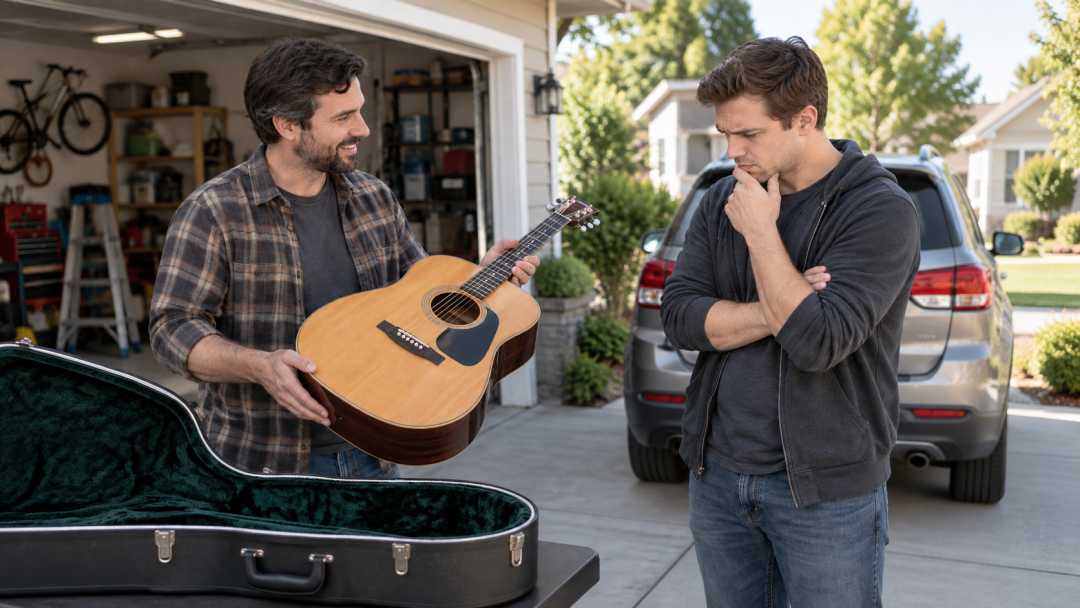
The Seller May Be More Honest Than You Think
If you’ve ever shopped for a used guitar on Facebook Marketplace, Craigslist or another online marketplace, you’ve probably wondered the same thing:
What’s wrong with it that the seller isn’t telling me?
Interestingly, new research suggests that sellers may actually be more honest than buyers expect.
A 2026 study published in Personality and Social Psychology Bulletin looked at negotiations involving used products with known defects. Across several experiments, buyers consistently underestimated how often sellers would disclose problems with the items they were selling. (DOI)
In one experiment, sellers were asked about a pair of used speakers that produced static. When directly asked whether the speakers had any problems, 85% of the sellers disclosed the defect. (Silicon Canals)
The researchers found that buyers tended to assume sellers were primarily interested in getting the highest price possible. Sellers themselves reported being considerably more concerned about honesty, fairness and doing the right thing than buyers expected. (DOI)
That’s encouraging.
But when you’re buying a used guitar, there’s another problem that may be even more important than whether the seller is honest.
The Seller May Not Know There’s a Problem
Most people selling a guitar aren’t guitar technicians.
They may honestly tell you:
- “Everything works.”
- “The neck looks straight.”
- “It plays fine.”
- “It just needs strings.”
- “It probably needs a setup.”
And as far as they know, every one of those statements may be completely true.
But we regularly see guitars with problems an average player or seller simply wouldn’t recognize.
A guitar can look perfectly good and still have:
- High or uneven frets
- Loose frets
- Excessive fret wear
- Nut slots that are too high or too low
- A poorly adjusted truss rod
- Neck-angle problems
- Worn electronics
- Scratchy pots or switches
- A loose output jack
- Bridge or saddle problems
- Tuning-machine issues
- Poor intonation
- Structural repairs that aren’t immediately obvious
Some of these are inexpensive to correct.
Others can turn your “great deal” into a fairly expensive guitar.
Ask Specific Questions
One particularly useful finding from the research was that sellers were more likely to disclose a problem when buyers asked a direct question rather than a general one. (Silicon Canals)
That makes sense when you’re buying a guitar too.
Instead of asking:
“Is there anything wrong with it?”
Ask questions such as:
“Are there any cracks or repaired cracks?”
“Does the truss rod work properly?”
“Are there any dead notes or buzzing frets?”
“Have any frets been replaced or leveled?”
“Do all the pickups, switches and controls work without cutting out?”
“Has the neck, headstock or bridge ever been repaired?”
“Does it stay in tune?”
“Are you aware of anything that needs repair?”
You’re much more likely to get useful information from specific questions than from asking someone to generally describe the condition of the guitar.
Don’t Confuse Honesty With Expertise
This is probably the biggest thing to remember when buying a guitar from a private seller.
An honest seller can still sell you a guitar with problems.
They aren’t necessarily hiding anything. They simply may not recognize fret problems, nut problems, neck-angle issues or other conditions that a professional guitar technician would spot immediately.
That’s why the researchers themselves caution that their findings aren’t an argument for blindly trusting every online seller. For an important used purchase, they recommend safeguards such as an independent inspection and a written description of the item’s condition. (Silicon Canals)
For guitars, we’d add one more:
Have the guitar inspected by a qualified guitar tech before you buy it whenever possible.
A $500 used guitar that needs $300 worth of work isn’t necessarily a bad guitar.
It just wasn’t a $500 guitar.
Sometimes the Marketplace Deal Really Is a Deal
None of this means you shouldn’t buy guitars from Craigslist or Facebook Marketplace.
There are some terrific guitars out there, and most sellers are probably just regular people trying to sell something they no longer use.
Do your homework.
Ask specific questions.
Play the guitar if possible.
Look it over carefully.
And if the price is high enough to hurt if you’re wrong, have a professional inspect it before handing over your money.
Or You Can Skip the Guesswork
Of course, there’s another option.
Every used guitar sold by Hank’s Guitar Shop has already been inspected by professional guitar technicians and is professionally set up before it leaves our shop.
And our used guitars come with a 90-day warranty.
So that Marketplace guitar might be a great deal.
The seller may be perfectly honest.
The guitar may be exactly what you’re hoping it is.
But why take chances when you don’t have to?
At Hank’s Guitar Shop, you can buy a used guitar knowing it’s been checked by people who know what to look for, professionally set up and backed by a 90-day warranty.
